
October 26, 2026
As of October 26, 2026, 7-hydroxymitragynine (7-OH) is not federally scheduled as a controlled substance, nor is it expressly listed in Oklahoma's controlled dangerous substance schedules. That may surprise readers who saw headlines this summer suggesting that the Drug Enforcement Administration (DEA) had banned 7-OH. In reality, the DEA's actions have been more limited, and a pending federal scheduling order could significantly change the legal landscape as early as November 13, 2026.
The distinction matters particularly in Oklahoma, where state law expressly incorporates substances temporarily or permanently controlled under federal law into its definition of a controlled dangerous substance. Consequently, federal scheduling can trigger Oklahoma criminal drug laws without additional action by the Legislature or state regulatory agencies. For retailers, distributors, and consumers, the DEA's pending action could therefore mean the difference between a product regulated under Oklahoma's kratom laws and one subject to criminal controlled-substance prohibitions.
What Are Kratom and 7-OH?
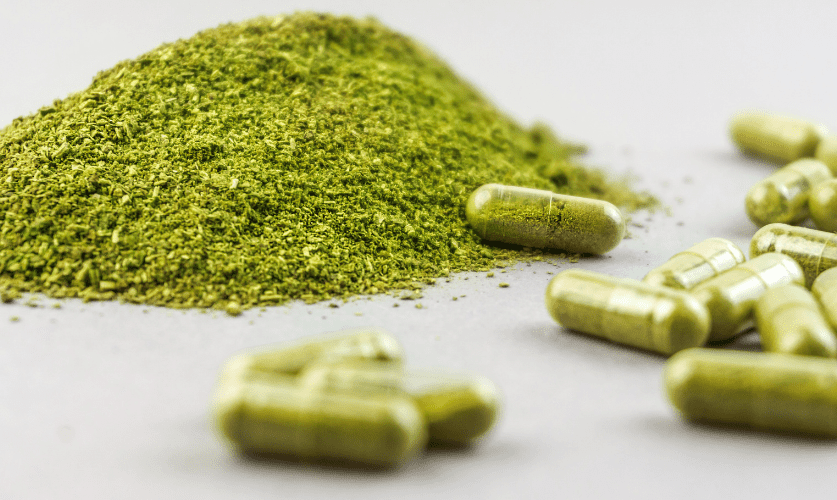
Kratom is a tropical tree (Mitragyna speciosa) native to Southeast Asia whose leaves contain naturally occurring compounds known as alkaloids. Kratom products are commonly sold as powders, capsules, teas, and concentrated extracts. Its principal alkaloid, mitragynine, interacts with opioid receptors in the brain and can produce stimulant-like or opioid-like effects. Although kratom is sometimes marketed for pain relief, increased energy, or management of opioid withdrawal symptoms, the Food and Drug Administration (FDA) has not approved kratom for any medical use.
7-Hydroxymitragynine, commonly called 7-OH, is another alkaloid associated with kratom. It occurs naturally in the plant in relatively small amounts but can also be produced through the chemical conversion of mitragynine. Compared with mitragynine, 7-OH has substantially greater activity at certain opioid receptors and is associated with more pronounced opioid-like effects. Commercial 7-OH products, including concentrated tablets, gummies, and extracts, may contain amounts far exceeding those ordinarily found in unprocessed kratom leaves.
The distinction between traditional kratom products and concentrated or chemically converted 7-OH products has become central to recent regulatory efforts. While Oklahoma generally permits the sale of kratom subject to restrictions on product composition and labeling, federal regulators have increasingly focused on concentrated 7-OH and related compounds. Whether a product contains naturally occurring alkaloids, synthesized compounds, or concentrations exceeding applicable thresholds can therefore have significant consequences under both state and federal law.
Oklahoma Currently Regulates Kratom Rather Than Prohibiting It
Oklahoma regulates kratom through the Oklahoma Kratom Consumer Protection Act, 63 O.S. §§ 1-1432.1 through 1-1432.5. Rather than categorically prohibiting kratom, the Act establishes restrictions on the preparation, distribution, labeling, and sale of kratom products. Neither kratom nor its principal alkaloids, mitragynine and 7-OH, are expressly identified in Oklahoma's controlled dangerous substance schedules, 63 O.S. §§ 2-204 through 2-212. Accordingly, possession of an otherwise lawful kratom product is not itself prohibited merely because the product contains naturally occurring mitragynine or 7-OH.
Under 63 O.S. § 1-1432.4(A), vendors may not sell kratom products containing 7-OH in an amount exceeding 1% of their alkaloid composition. House Bill 3574, effective November 1, 2024, reduced that limit from the previous 2% threshold. The Act also prohibits products containing synthesized kratom alkaloids, including synthesized mitragynine and synthesized 7-OH, as well as products contaminated with certain dangerous substances or containing controlled substances. Vendors are additionally prohibited from selling kratom products to individuals under 18. Oklahoma also imposes labeling requirements, and Senate Bill 891, effective November 1, 2025, requires vendors to provide qualifying independent laboratory test results upon request by the Oklahoma State Department of Health.
The Act's penalties are primarily administrative. Under 63 O.S. § 1-1432.5, the owner or manager of a noncompliant vendor may face a penalty of up to $500 for a first offense and $1,000 for a second offense. A third offense results in a three-year prohibition on selling kratom products, and selling during that prohibition constitutes a misdemeanor punishable by up to one year in county jail and a fine of up to $2,000. The Act also authorizes a private civil action by a person aggrieved by a violation. These penalties differ substantially from those imposed under Oklahoma's criminal controlled-substance laws.
What the DEA Has Done and What May Happen in November
The DEA has taken several steps toward scheduling kratom-derived compounds in 2026, but its actions have involved different substances and different thresholds. On July 6, the agency announced its intent to temporarily place mitragynine pseudoindoxyl (MP), MGM-15, and MGM-16 into Schedule I. The following day, it published a separate notice proposing temporary scheduling of 7-OH above a specified threshold.
On August 26, 2026, the DEA issued a temporary order placing MP, MGM-15, and MGM-16 into federal Schedule I. See91 Fed. Reg. 54948 (Aug. 26, 2026). That order took effect immediately upon publication and generally remains effective for two years, subject to a possible statutory extension. Importantly, the August order did not schedule 7-OH itself, despite public reporting that sometimes failed to distinguish it from the compounds covered by the order.
The DEA subsequently revised its approach to 7-OH. Following an October 8 recommendation from the Department of Health and Human Services, the agency withdrew its earlier 7-OH notice and published a new notice of intent on October 14, 2026. See 91 Fed. Reg. 65370 (Oct. 14, 2026). The new proposal addresses both 7-OH and MP and would impose Schedule I controls when either of two thresholds is met: the concentration of 7-OH or MP, individually or combined, exceeds 1 milligram per gram in solid products or 1 milligram per milliliter in liquids; or the ratio of mitragynine to 7-OH, MP, or their combined mass is less than 100.
The DEA may issue the new order on or after November 13, 2026, with the controls taking effect upon publication. That date is the earliest possible issuance date, not a guaranteed effective date. The proposed order would also replace the existing temporary scheduling of MP with a threshold-based approach, while MGM-15 and MGM-16 would remain controlled under the August order. Until a replacement order takes effect, MP remains federally controlled without the proposed threshold limitation.
Why Federal Scheduling Changes Oklahoma Criminal Law
The most significant consequence of the DEA's pending action arises from Oklahoma's definition of a controlled dangerous substance. Under 63 O.S. § 2-101(11), the term includes substances listed in Oklahoma's controlled dangerous substance schedules as well as those “listed either temporarily or permanently as a federally controlled substance.” This language incorporates federal scheduling decisions into Oklahoma law without requiring the Legislature to separately amend the state's schedules.
Consequently, MP, MGM-15, and MGM-16 have fallen within Oklahoma's statutory definition of a controlled dangerous substance since the DEA's August 26 order took effect. Conduct involving those compounds may implicate Oklahoma's criminal drug statutes, including 63 O.S. § 2-402, governing unlawful possession, and § 2-401, governing unlawful manufacture, distribution, and possession with intent to distribute. The applicable offense and punishment depend on the substance, alleged conduct, and relevant statutory provisions.
If the DEA proceeds with its proposed temporary scheduling of 7-OH, products meeting the final federal criteria would likewise fall within Oklahoma's definition of a controlled dangerous substance upon the order's effective date. No separate Oklahoma legislation or administrative scheduling action would be required. This could substantially change the legal consequences of conduct involving certain 7-OH products. Under the Kratom Consumer Protection Act, selling an over-limit product generally presents a regulatory enforcement issue directed at the vendor. Under Oklahoma's controlled-substance statutes, possession or distribution of a scheduled substance may expose individuals, including retailers, employees, and consumers, to criminal prosecution.
An additional complication is that Oklahoma's existing 1% restriction and the DEA's proposed thresholds measure different things. Oklahoma measures 7-OH as a percentage of a product's alkaloid composition, while the federal proposal considers both its absolute concentration and its ratio to mitragynine. A concentrated extract could therefore satisfy Oklahoma's percentage limit while exceeding the proposed federal concentration threshold. Similarly, a product containing less than 1% 7-OH by alkaloid composition could nevertheless have a mitragynine-to-7-OH ratio below 100.
Compliance with Oklahoma's existing kratom restrictions would not necessarily establish compliance with the proposed federal scheduling criteria.
What's Next for Kratom and 7-OH in Oklahoma?
Federal scheduling is not the only potential development. On September 18, 2026, Representative Tim Turner announced plans to introduce legislation during Oklahoma's 2027 legislative session to place 7-OH, mitragynine pseudoindoxyl, and MGM-15 into the state's own Schedule I. Oklahoma Bureau of Narcotics Director Donnie Anderson has publicly supported the proposal. Although no such legislation has yet been enacted, a separate Oklahoma scheduling statute could have consequences beyond the DEA's temporary order. Federal temporary scheduling generally expires after two years, subject to a possible one-year extension, while an express state statutory listing would not automatically expire with the federal order. Oklahoma lawmakers could also adopt stricter restrictions or different thresholds.
For retailers and distributors, the immediate priority is understanding which products are already controlled and which may become controlled under the DEA's pending action. MP, MGM-15, and MGM-16 are already subject to federal scheduling, while products containing 7-OH should be evaluated against both Oklahoma's existing requirements and the DEA's proposed concentration and ratio thresholds. Because the new order may take effect upon publication, businesses should not assume they will have additional time to dispose of inventory once the DEA acts.
Ultimately, the significance of the pending federal order extends beyond the legality of particular kratom products. Oklahoma law expressly incorporates federal temporary scheduling into its definition of a controlled dangerous substance, meaning that a federal administrative action can have immediate consequences under Oklahoma's criminal drug statutes. As the legal landscape continues to develop, the identity and composition of a substance, the date of the alleged conduct, and the scheduling provisions in effect at that time may become central issues in Oklahoma criminal cases.
This article provides general legal information as of October 26, 2026. It is not legal advice and does not establish an attorney-client relationship.
Sources
Oklahoma Kratom Consumer Protection Act, 63 O.S. §§ 1-1432.1–1-1432.5.
Oklahoma Uniform Controlled Dangerous Substances Act, 63 O.S. §§ 2-101, 2-401, and 2-402.
DEA Temporary Scheduling Order, 91 Fed. Reg. 54948 (Aug. 26, 2026).
Congressional Research Service, Temporary Control of 7-OH and Other Kratom-Related Substances.
Oklahoma House of Representatives, Rep. Turner Announcement (Sept. 18, 2026).